Longer pieces on the designer, the aircraft, and the people who've kept them flying.
René Fournier was a French aeronautical engineer with almost no formal training in the field — a spell at an aviation mechanics school in Rochefort, wood-and-fabric construction learned from a craftsman named Barret de Nazaris at Cahors, and early guidance from designer and test pilot Charles Fauvel, who flew the RF1's first flight at Cannes. From that unlikely start he spent six decades designing one of the most distinctive families of light aircraft ever produced: motorgliders slender and clean enough to soar for hours with the engine stopped, built from wood, fabric, and later composite, and licensed or copied by manufacturers across Europe, South America and beyond.
His first design, conceived in the late 1940s and finally built in 1960, was the RF1 — what he described as wanting a "poet's aeroplane", closer to a soaring bird than a powered aircraft. Every subsequent RF-series design, from the RF2 through to the composite RF10, worked variations on that same basic formula: a fine, high-aspect wing, a small and often car-derived engine, and enough aerodynamic cleanliness to glide properly once that engine stopped.
Commercially, Fournier's career was a story of near-constant financial hardship set against real engineering success. Production repeatedly moved between companies and countries — Alpavia in France, Sportavia in Germany, later ventures in Spain — as funding ran out, currencies moved against him, or French officials declined to support a domestic industry they didn't fully understand. He was made bankrupt when his own company collapsed in 1977, rebuilt his position working for the buyer who rescued it, and kept designing into his seventies with the RF47. He continued advising former customers and owners informally long after his formal retirement from aviation.
Fournier told his own story in an autobiography, published in French as Mon rêve et mes combats and later translated into English by Bob Grimstead as My Dreams and My Aeroplanes — a title that captures the tone of his career about as well as anything could.
A note on the date above: the most recent confirmation found for this page was a French tribute marking his 103rd birthday in April 2024. We haven't found anything more recent either way — if you have a current update, the contact page is the way to reach us.
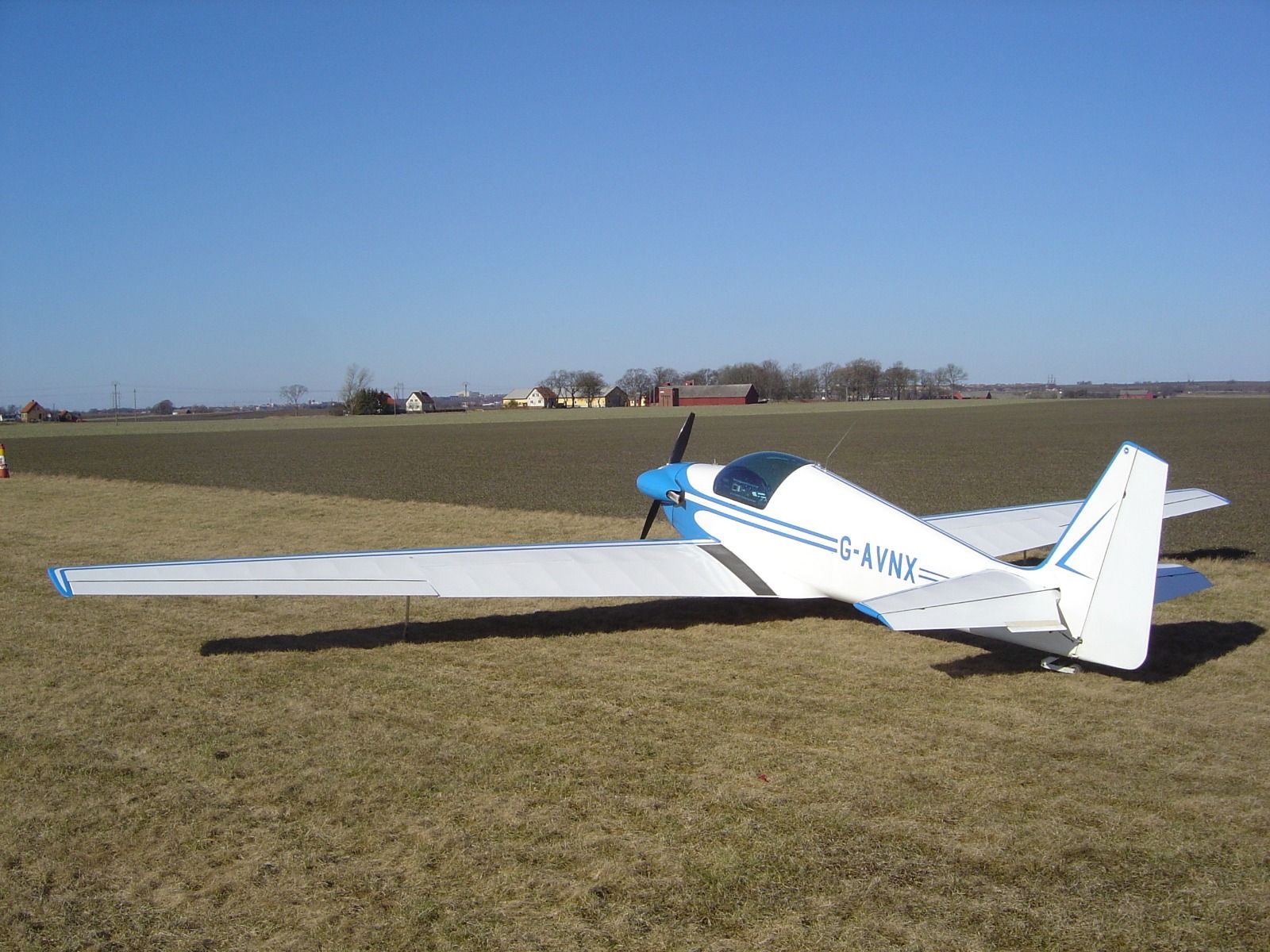
In 2004, a Swedish pilot named Jörgen bought RF4 G-AVNX from a Bicester-based seller — James, this club's own founder — and flew it home himself: Bicester to Landskrona, four countries, a broken forearm, a Bonfire Night send-off, low cloud down the German coast, and a pair of missing tailwheel springs discovered only after touchdown. Thirty photos, full radio transcripts, and genuinely lovely writing.
Each of these is the whole original, shown page for page — not a summary.

Mira Slovak’s own account of flying an RF4D from West Germany to California, with prologue pages by Merl Dobry.
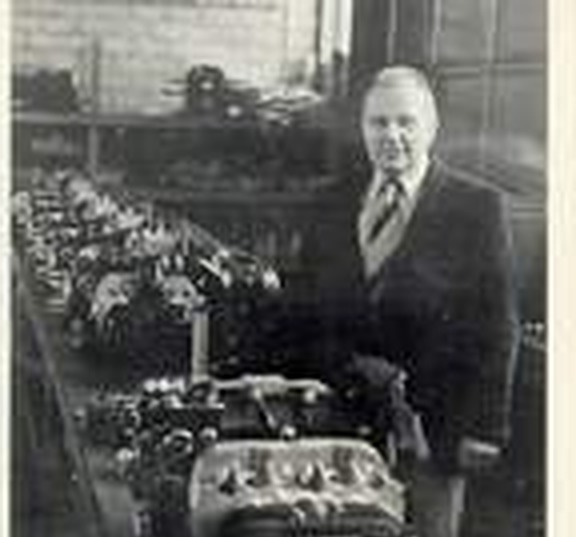
John P. Cropp visits Peter Limbach’s engine works in West Germany. All eight pages.
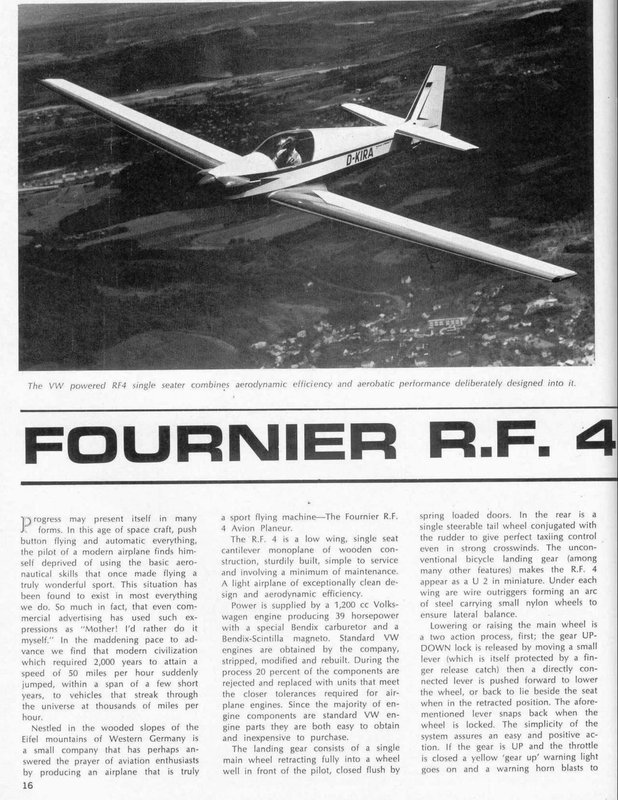
George H. Budde’s photo essay from inside the Sportavia works. All four pages.

Peter Turner’s account of taking on and finishing the restoration of RF4D G-AVWY.
Club Fournier International–America holds full-page scans of these articles, and its owner has given permission for material from his site to be used here.
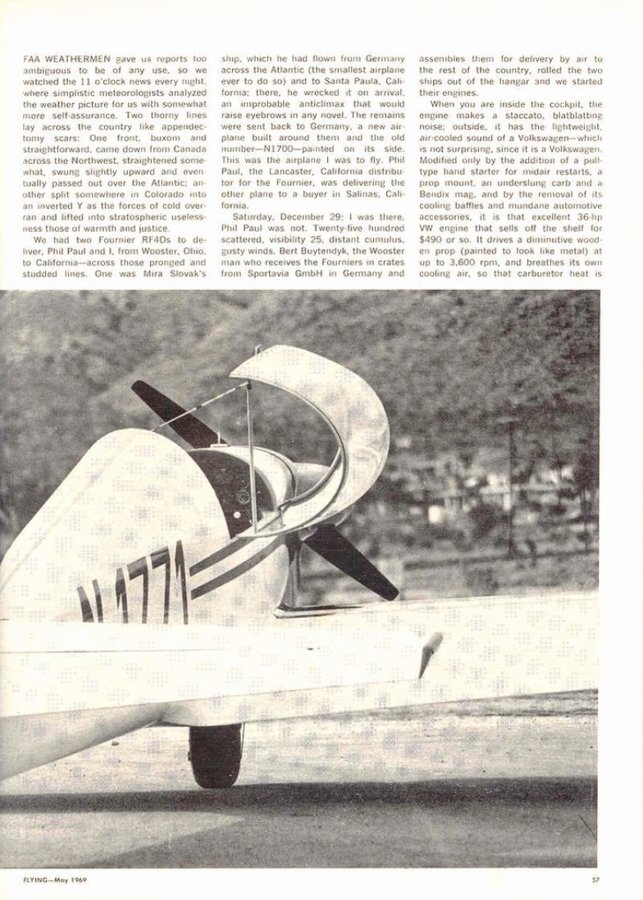
Taking a Fournier RF4D across the American Southwest, complete with snowstorm and hand-swung propeller. Credited by CFI America to Peter Garrison.
Jack Lambie’s two-part account of cross-country soaring in a Fournier, with his own photographs.
.jpg?width=900)
Pilot magazine’s RF4D flight test. External site.
.jpg?width=900)
Pilot magazine’s history of the Fournier designs. External site.
More original articles. The CFI worldwide page links to the wider archive at CFI America — around eighty magazine articles, brochures and clippings, including Fournier in the UK (Pilot, 1968) and the 1998 Motorglidering International report on the rebuild of G-AVNX — and to the scans already on our own magazine shelf.
Copyright note. Third-party articles and photographs remain the copyright of their authors and publishers. Those from CFI America are used with its permission; external links point to the publishers’ own sites.
Open the full Magazine Shelf →
A growing shelf of period tests, features and Fournier material from aviation magazines and specialist archives. Where the original article is hosted elsewhere, we link to it rather than republishing it here.

The RF7 is exceptionally rare. This archive includes photographs of G-LTRF and links to additional historic records.
Browse RF7 photographs ↗
The sole RF8 prototype survives at the Musée régional de l'air d'Angers-Marcé. The Commons image and its licensing details are recorded in our photo credits.
View RF8 archive image ↗
We are building a linked bibliography of period magazine coverage. Pilot Magazine references include RF4D features from 2001 and 2005 and the RF4UL from 2011.
Read the RF4D flight test ↗Copyright note. These links point to external hosts and archives. The UK Fournier Club does not claim ownership of third-party magazine scans or photographs. We will add links to legitimate publisher/archive copies as they become available.