Period flight tests, club archives, brochures and modern features — a growing reading room for anyone who wants to go deeper.
Start here: Club Fournier International has a dedicated magazine archive arranged by aircraft type, including RF-01, RF-02, RF3, RF4/RF4D, RF5, RF6, RF47, RF7, RF8, RF9 and RF10/Ximango. Their archive asks readers with additional material to send it in, so this is likely to keep growing.
Also worth the detour: Older references to the former CFI America archive are retained as bibliography leads where useful; when a direct scan is no longer reliably reachable, the link now takes you to the current CFI International magazine archive instead.
The team's own newsletter on its twin-RF4D display, credited to team manager Joy Frazer and Patrick Fitz-Gibbon. It covers the display's 1983 origins with pilot John Taylor and Tiger Club associate Brendan O'Brien, the move to Unipart sponsorship for the 1987 season, the routine itself — around 14 manoeuvres flown to Pink Floyd's "Shine on You Crazy Diamond" with wingtip smoke and a signature gliding mirror pass — the team's European touring diary, and a line-up of the pilots and crew. Pages run 7 to 11, reordered here to match the printed page numbers and the sentence carried across each page break.
Read the newsletter (PDF) ↗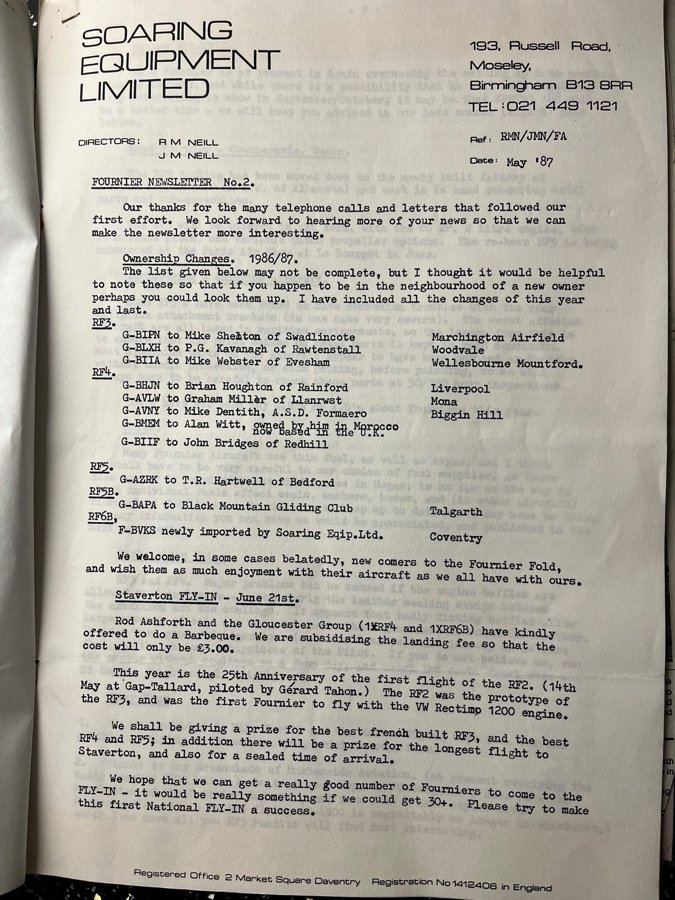
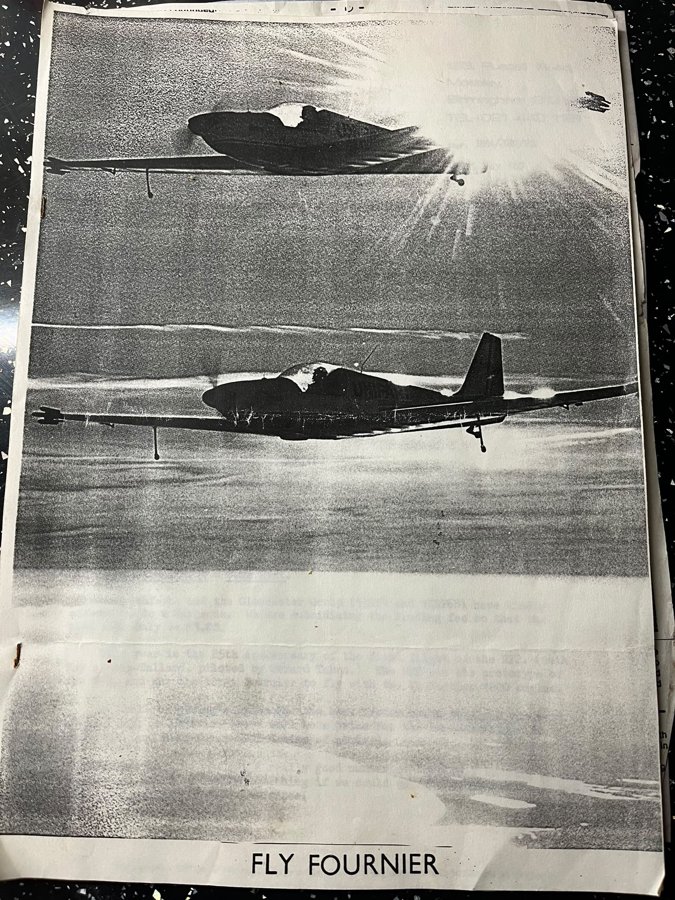
Robert and Joy Neill's newsletter for UK Fournier owners: ownership changes across the RF3 to RF6B fleet, a Staverton fly-in marking the RF2's 25th anniversary, an update on René Fournier's RF5 kit relaunch in Spain, and maintenance notes on tailplane corrosion, mogas and carburettor icing. The same issue reprints David Sutherland's "Fournier Flying" account of his RF5 G-AZJC — bought new in 1972, an ambitious tour through France, the Alps, Florence and Elba, and his notes on the type's crosswind quirks, aerobatics and gliding. Opens with the "Fly Fournier" photograph credited to Joy Frazer; pages run 1, 2, 3, 5, 6 — page 4 wasn't among the scans, so the article has a short gap partway through.
Read the newsletter (PDF) ↗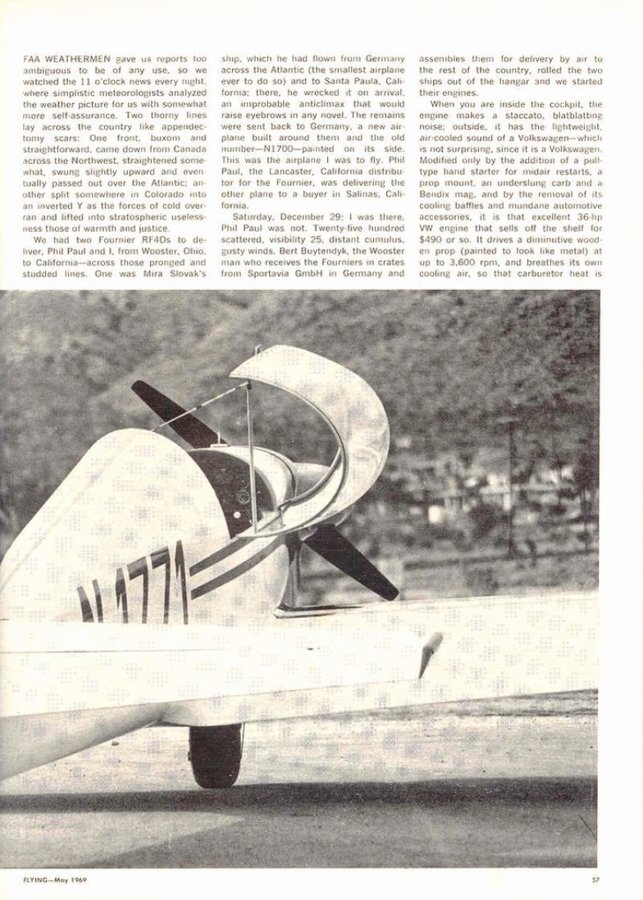
Two RF4Ds delivered by air from Ohio to California, flown by the author and Phil Paul, dodging snowstorms, headwinds and an unpressurised three-day slog across the Rockies and the desert Southwest — fuel logs, tiedowns under the stars, and a dwarf winter sun the whole way. Pages 57, 58 and 60; page 59 wasn't among the scans.
Read the article (PDF) ↗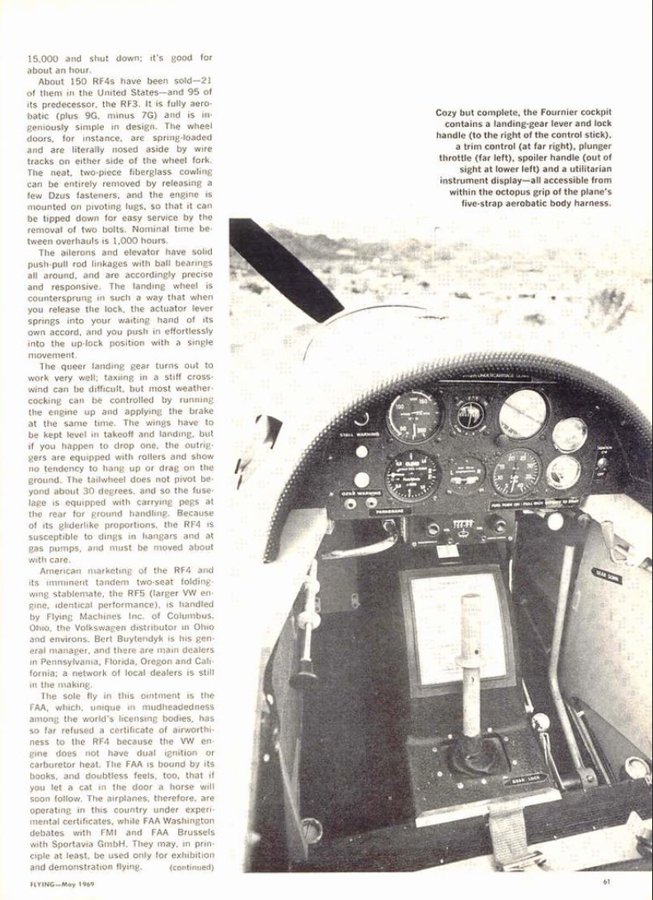
A shorter companion piece from the same FLYING issue as "Cheap Thrills": Capt. Foster's back-pack 'chute and N1771's cockpit, gear-retraction quirks, roll rate and a candid note on the type's largely-untested FAA "Experimental" status. Page 55, with two preceding pages.
Read the article (PDF) ↗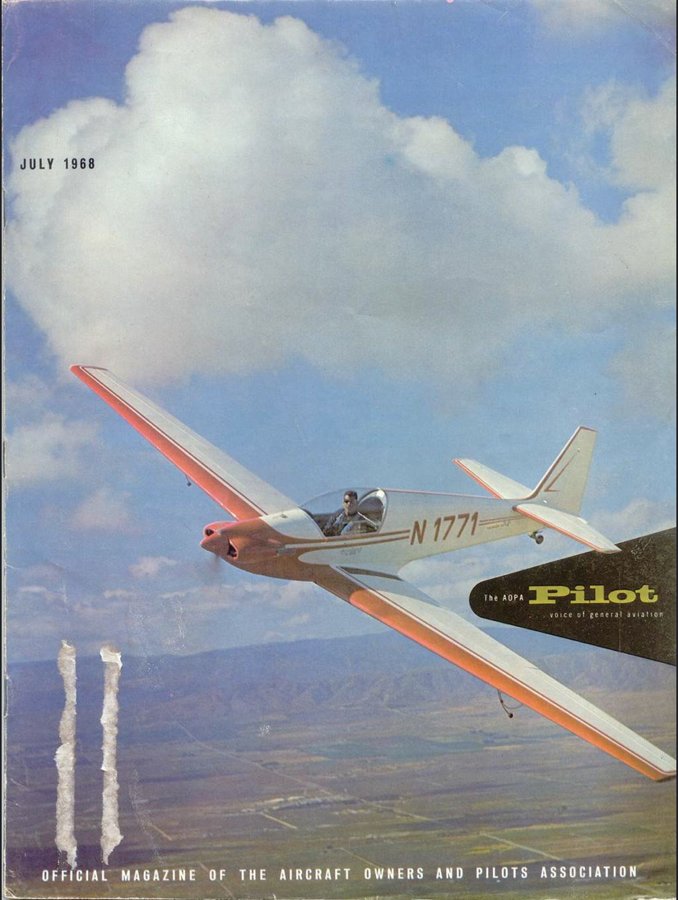
Don Downie's early US pilot report — among the first American magazine coverage of the type — with Phil Paul demonstrating N1771 at Fox Field, Lancaster. Cover and page 52.
Read the article (PDF) ↗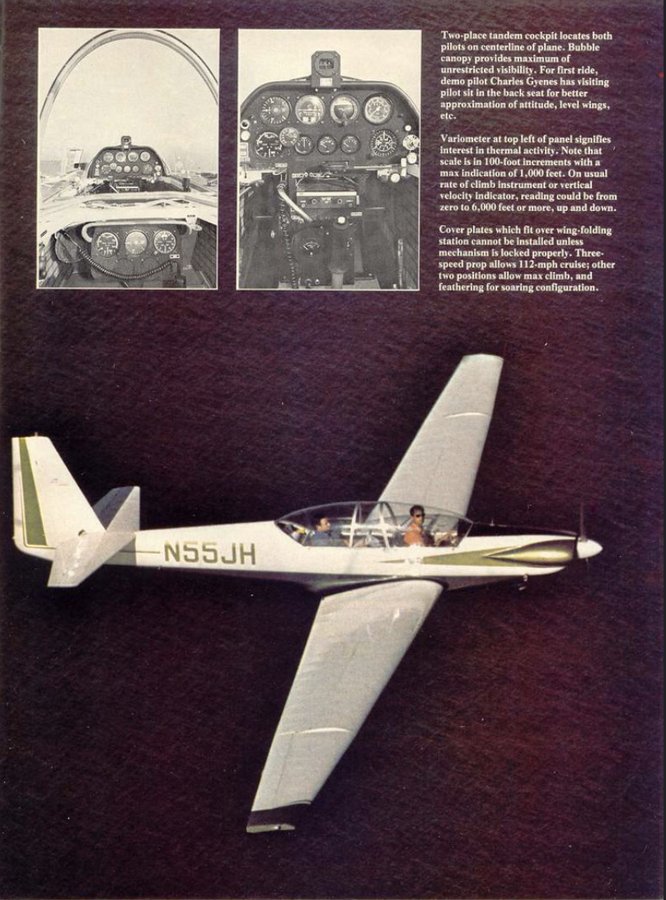
Gordon Baxter's characteristically wry account of flying the Sperber RF5B, US distributor Bert Buytendyk's Wooster, Ohio operation, and a memorable interview with designer Alfons Pützer, who "did not regard the Sperber as anything more than a sailplane of independent means."
Read the article (PDF) ↗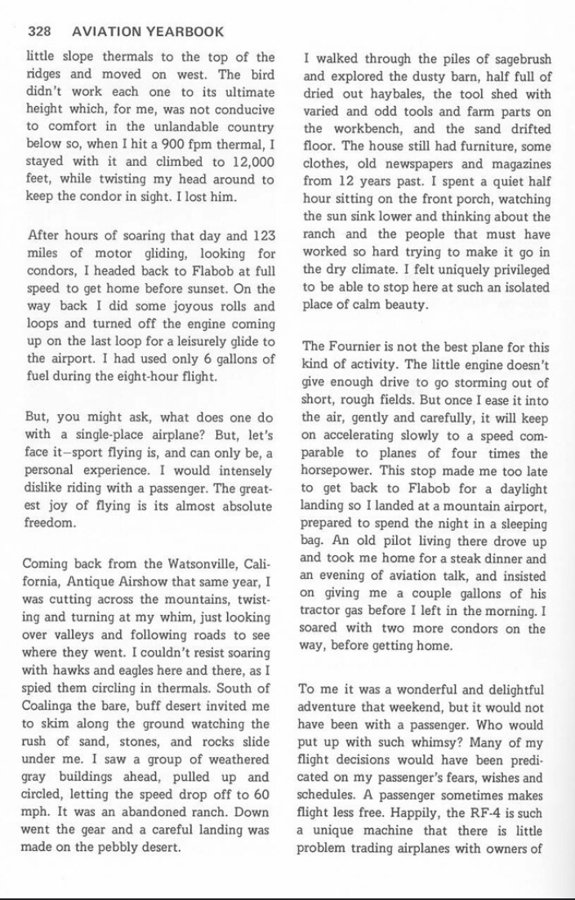
A single-page personal essay on motorgliding solo out of Flabob, California — thermalling with condors and hawks, an unplanned overnight at a mountain strip, and a case for why the single-seat RF-4 suits this kind of flying better than it first seems.
Read the article (PDF) ↗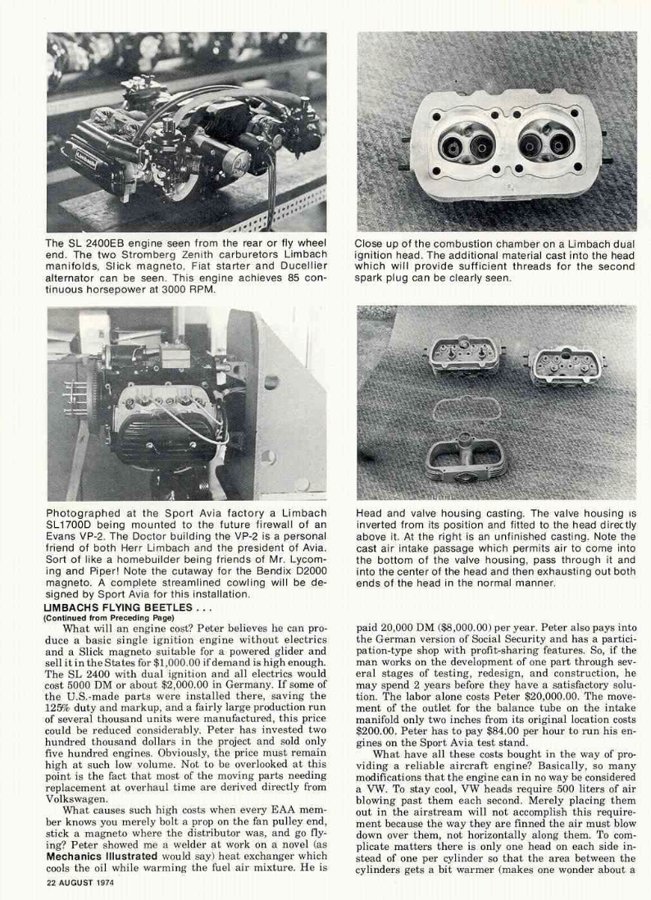
A close look at the Limbach SL1700D and SL2400EB VW-derived aircraft engines used across the Fournier range — dual-ignition heads, the economics of small-batch engine building in Germany, and a Sport Avia factory shot of an SL1700D being fitted to an Evans VP-2.
Read the article (PDF) ↗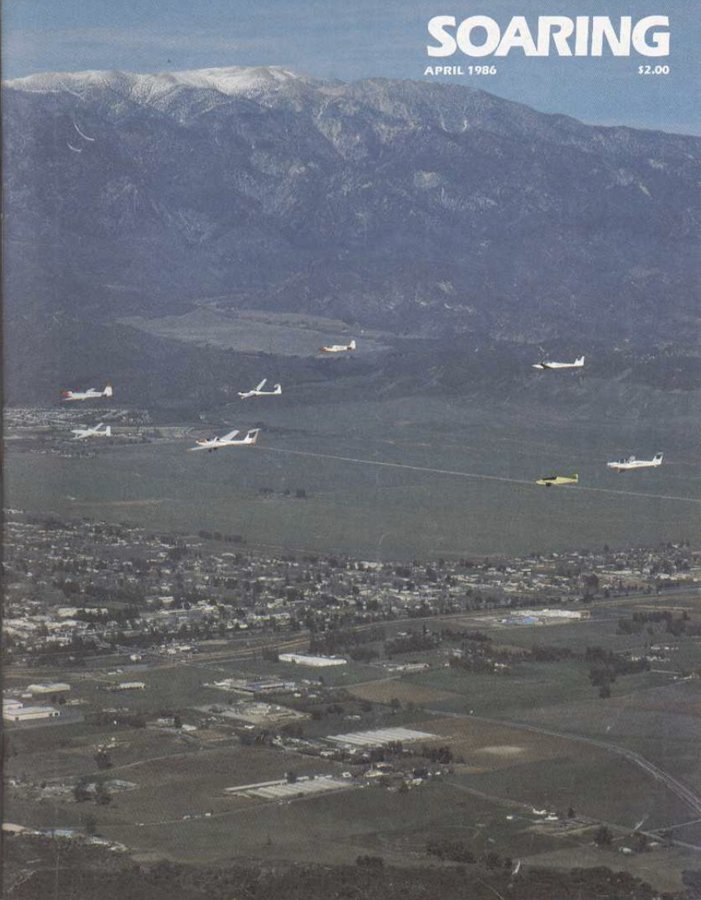
Jeri Treager's report on the Hemet-Ryan motorglider rally, with a Fournier flying formation alongside a PIK, a Silhouette and a Taifun. Cover and page 21.
Read the article (PDF) ↗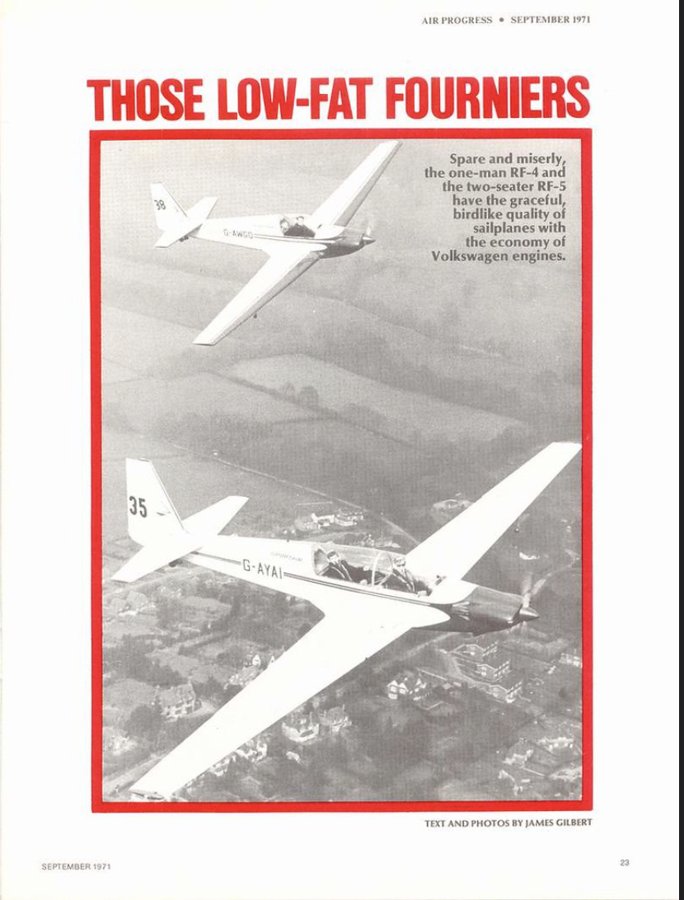
James Gilbert's tour of the RF-4 and RF-5 at Sportair, Biggin Hill — a flashback to the 1964 Cannes Air Show and the RF-3, ground handling and gear-lever quirks of both types, and an RF-5 flight test with instructor Rob Dorsey. Pages 23, 24, 25 and 27; page 26 wasn't among the scans.
Read the article (PDF) ↗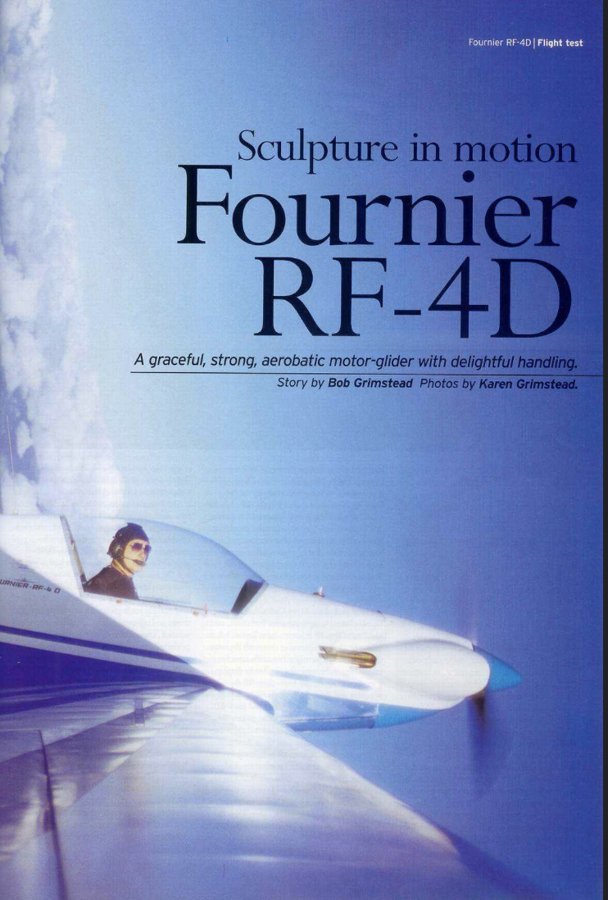
Bob Grimstead's flight test, photographed by Karen Grimstead — the type's construction and handling, ownership history back to 1970, and a "Praised by Pilots" sidebar quoting John Taylor, Brendan O'Brien and other UK display and owner pilots. Title page, page 48 and page 50; page 49 wasn't among the scans.
Read the article (PDF) ↗
Period brochures are one of the best ways to see how Fournier aircraft were actually presented to pilots at the time — including the RF3, RF4, RF5, RF6B, RF7, RF8, RF9 and RF10/Ximango.
Browse the brochures ↗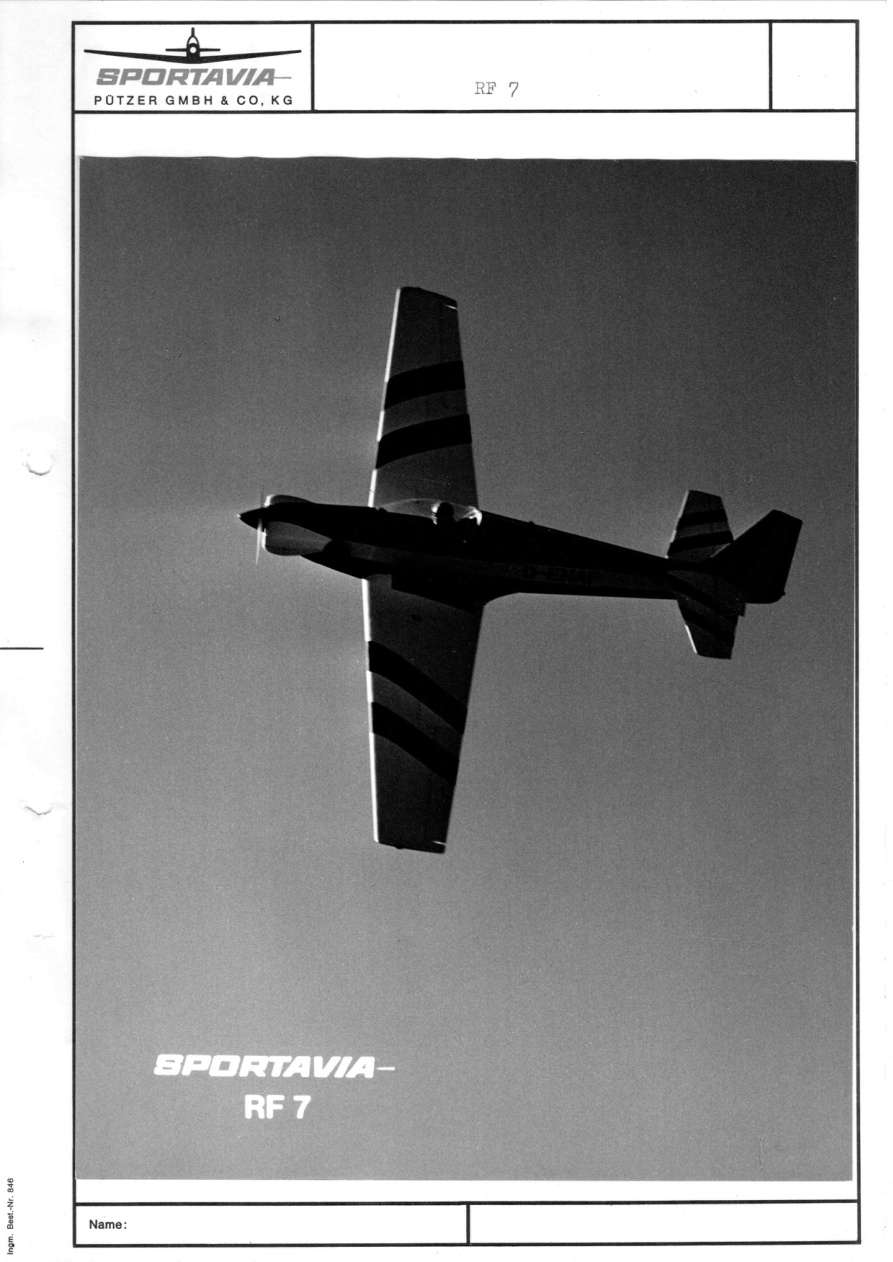
A two-page Sportavia-Putzer brochure for the Fournier RF 7, presented as a fast single-seat motorglider for cruising, racing and aerobatics. The scan includes the original RF 7 photographs, bilingual German/English sales text and contemporary equipment highlights. The date is not stated on the scan.
Read the brochure (PDF) ↗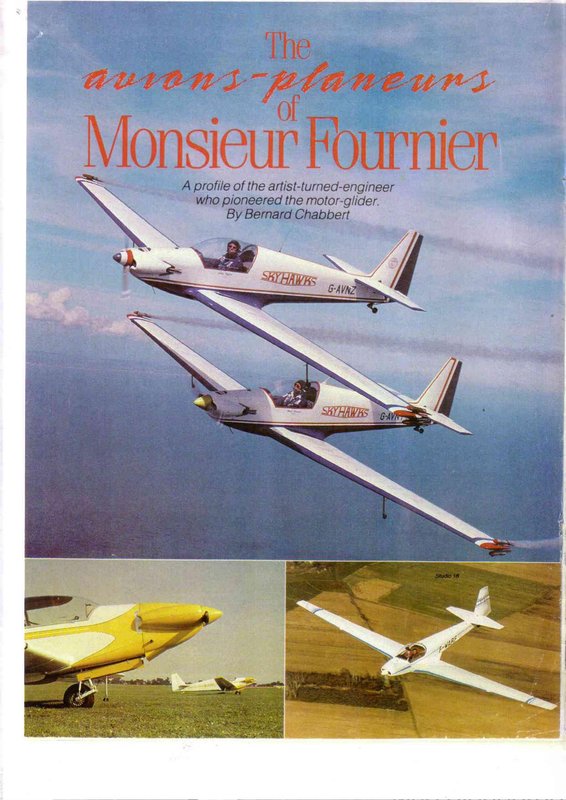
Bernard Chabbert's profile of René Fournier and his aircraft, flown from the RF3 through to the RF9. Includes a lovely aside on two RF4Ds performing a Skyhawks display routine to Pink Floyd, and picks the all-metal RF8 — "the poor man's U-2" — as the writer's favourite of the whole family.
Read the article (PDF) ↗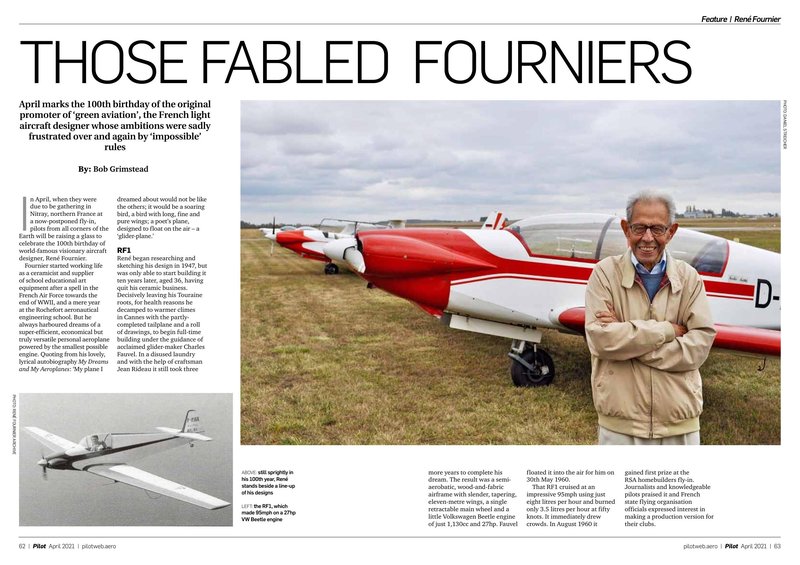
Bob Grimstead's centenary profile of René Fournier, marking his 100th birthday — a type-by-type run through the whole family from the RF1 to the RF4UL, including the derivatives built by Slingsby, Aéromot and others.
Read the article (PDF) ↗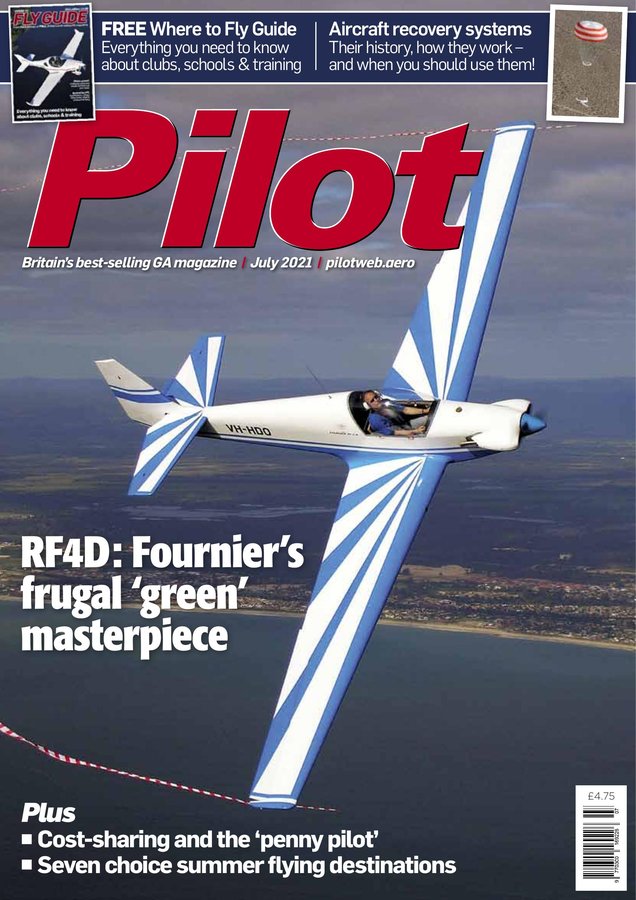
Bob Grimstead — RF4D owner and display pilot — on flying his own aircraft: a full cockpit walkthrough, what makes the type's aerobatics so cheap to fly, and a fifty-year account of his own affair with the marque.
Read the article (PDF) ↗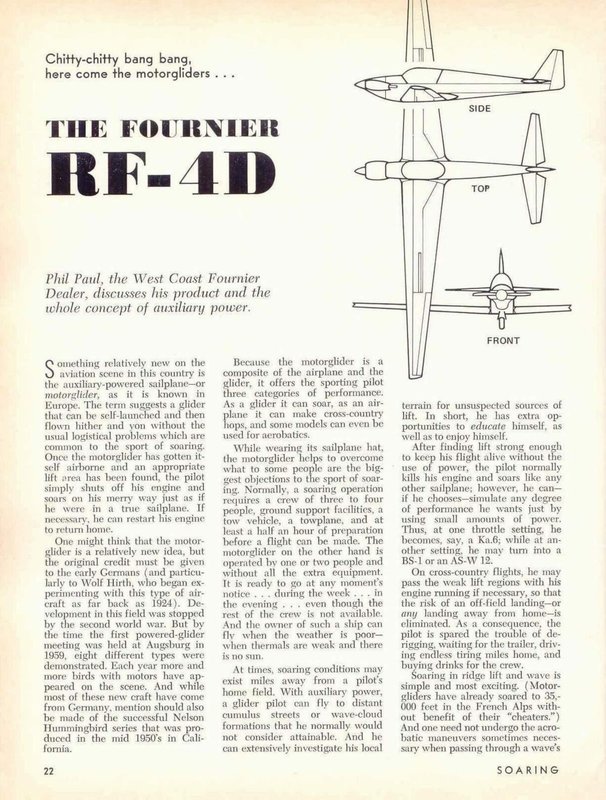
Phil Paul, then the West Coast Fournier dealer, makes the case for auxiliary-powered sailplanes generally and the RF4D specifically — full US-market specifications, a comparison flight against a Cessna 150, and a snapshot of the whole 1968 motorglider field (Scheibe, Schleicher, Nelson Hummingbird and more).
Read the article (PDF) ↗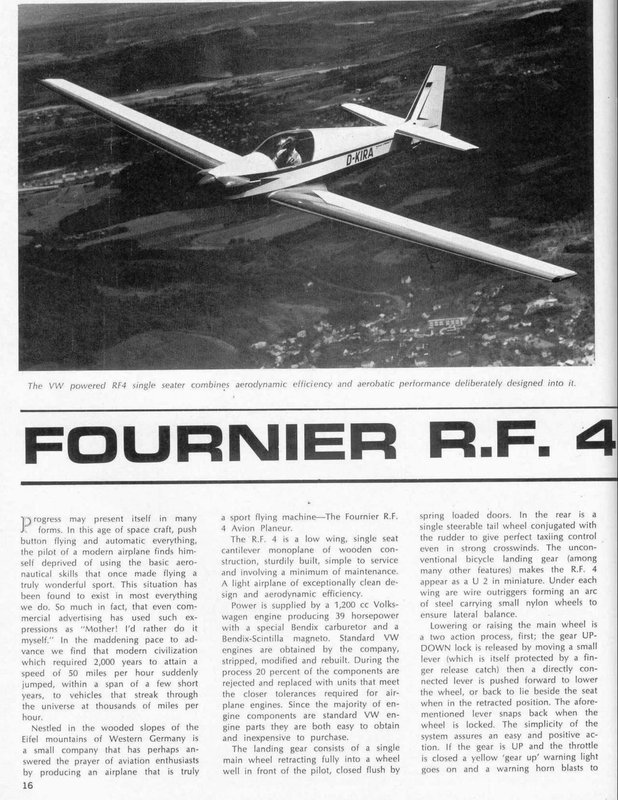
George H. Budde's photo essay on the RF4 "Avion Planeur" — a tour of the Sportavia factory at Dahlemer Binz, full US pricing and equipment lists, and a first look ahead at the still-in-flight-test RF5. (Exact issue month not confirmed — filed here under 1968 based on internal references.)
Read the article (PDF) ↗Bob Grimstead's five-part Pilot magazine series on rebuilding not one but two Fournier RF6Bs — including the original prototype itself. A rare first-hand account of what it actually takes to keep an orphaned, decertified type flying today.
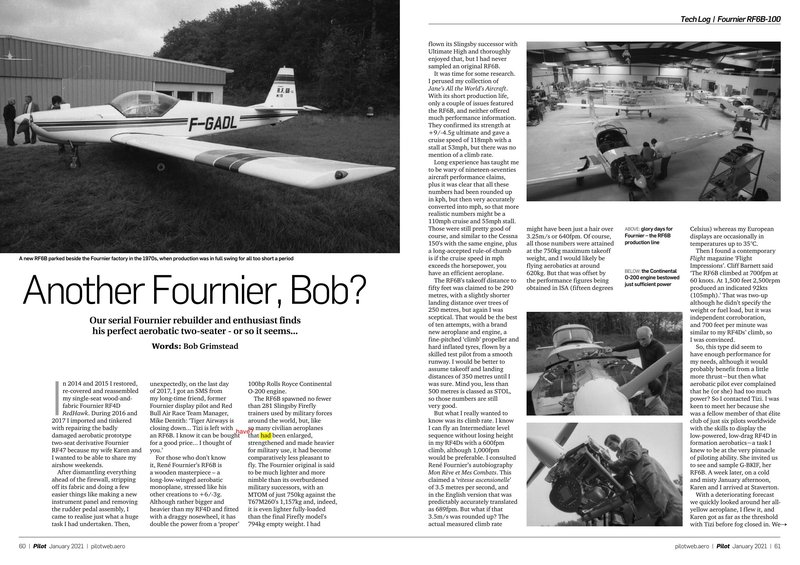
How a New Year's Eve text message about a bankrupt stock sale led Bob Grimstead to two derelict RF6Bs at Staverton — and why he ended up buying the less flyable one, "Whisky Hotel" G-BLWH, for £2,000.
Read Part 1 (PDF) ↗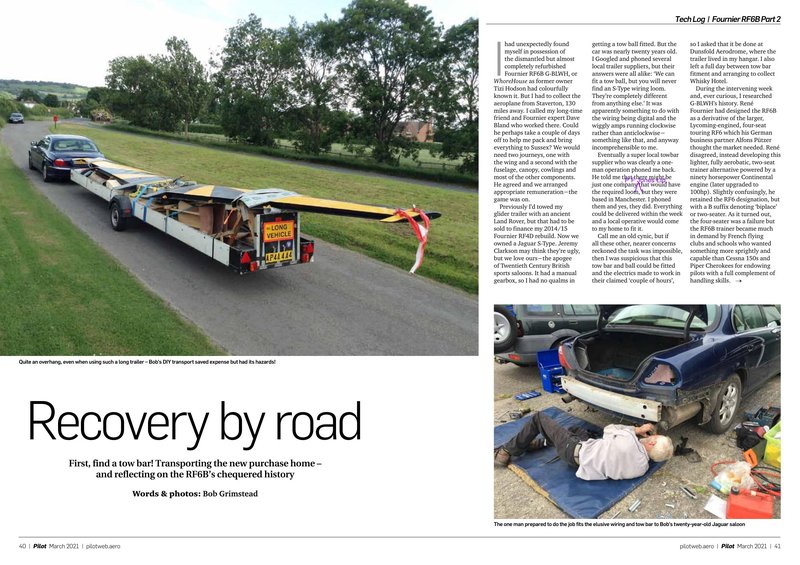
Fitting a tow bar to a twenty-year-old Jaguar, hauling the wing and fuselage home from Staverton, and G-BLWH's full production history — factory to F-GADF, seventh off the line, 6 September 1976.
Read Part 2 (PDF) ↗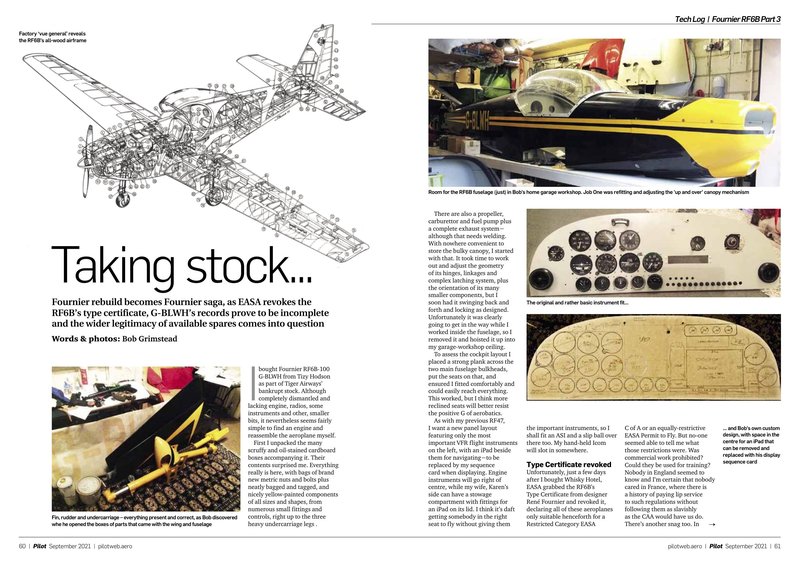
Days after buying Whisky Hotel, EASA revoked the RF6B's type certificate outright. The bureaucratic fallout — Restricted Category C of A, an LAA Permit to Fly, and why a genuine Slingsby T67 component is legally unusable on an RF6B despite being identical.
Read Part 3 (PDF) ↗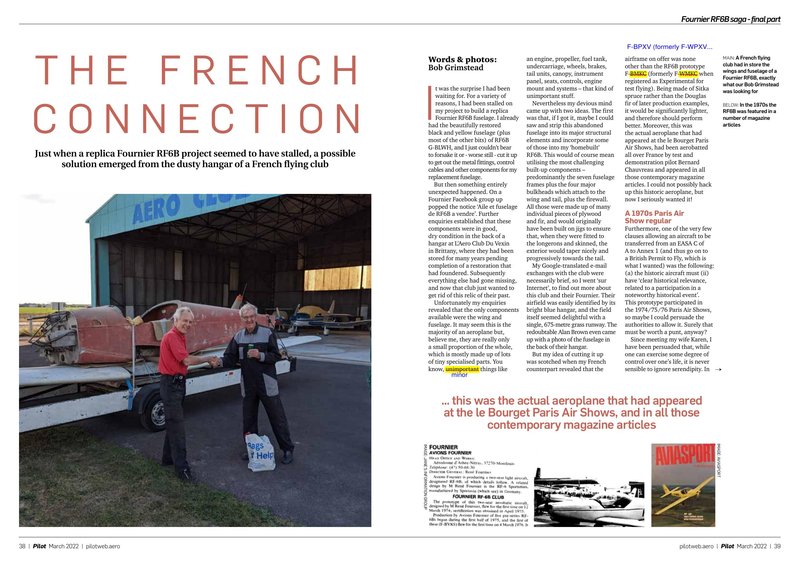
A Facebook post leads to the actual RF6B prototype, F-BPXV — the very airframe that appeared at the Paris Air Show in 1974–76 — abandoned in a French club's hangar, and a Jaguar-and-trailer road trip across Normandy to bring it home.
Read Part 4 (PDF) ↗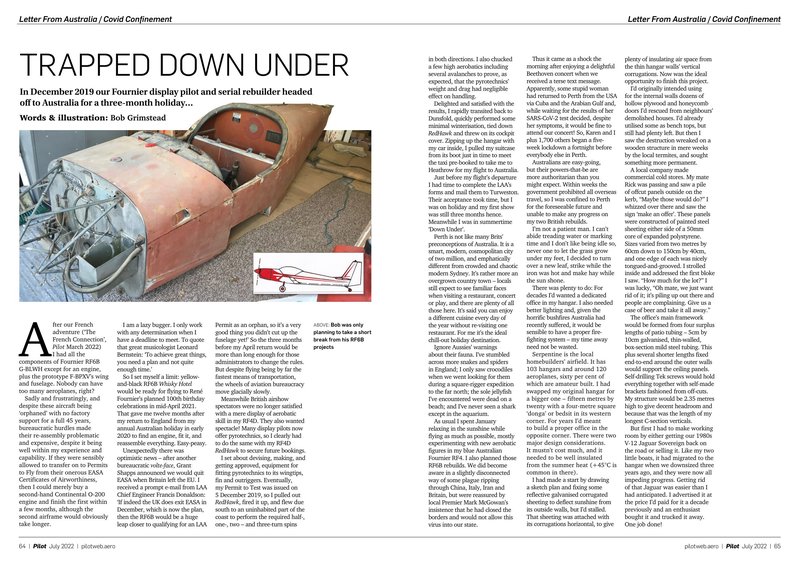
An Australian holiday turns into a five-week COVID lockdown, and Bob channels the enforced downtime into hangar improvements while the two RF6B rebuilds — and the search for a spare engine — wait back in England.
Read Part 5 (PDF) ↗Where a magazine scan is already hosted elsewhere, the UK Fournier Club links to that original archive rather than copying it into this website. A handful of pieces above are hosted directly here instead, contributed to the club with permission to share.
We will keep adding links as legitimate scans, publisher pages and club archives turn up. If you have an old Fournier article, send us the publication name, date and aircraft type and we can add it to the index.
RF2 coverage is particularly scarce. Old club magazines, flight-test reports and photographs are exactly the kind of material worth preserving.
Email us about your archive →